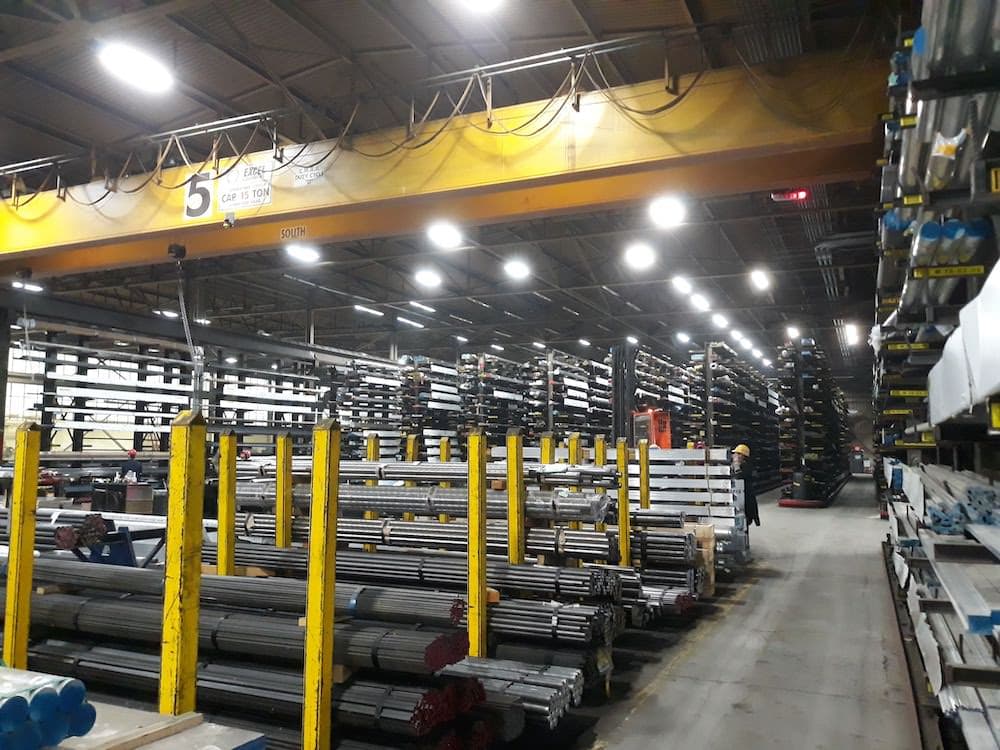
Reshoring is bringing steel service centers back to America.
Market Growth
U.S. steel service center market growing at 3.5-3.75% CAGR through 2035. Distribution is outpacing mill services.
Pop-Up Steel Centers
Bulldog's VNA cantilever + rack-supported buildings:
- 60% more density
- 6-9 month deployment
- Inside mills or regional
Zero Capex Expansion
Lease the entire system:
- Rack-supported building
- VNA racking system
- Forklifts included
- One monthly payment
Scale without balance sheet impact. Deploy in 90 days.
MSCI members: Move faster than your competition.
As manufacturing reshoring accelerates and infrastructure spending surges, steel service centers are quietly transforming to meet new demands. The question on everyone's mind: will this bring back the regional service center model?
The answer is yes—but not in the way you might expect. The next generation of steel service centers won't look like the sprawling facilities of the past. They'll be compact, highly automated, and strategically positioned closer to manufacturing clusters and construction markets.
Steel Service Center Market: Growth Through 2035
The U.S. steel service center market is projected to grow at a compound annual growth rate of 3.5-3.75% through 2035. While that might seem modest, it represents billions in new investment and a fundamental shift in how steel reaches end users.
Key growth drivers include:
- Manufacturing reshoring creating localized demand
- Infrastructure spending (bridges, highways, renewable energy)
- Automotive sector evolution (EVs require different steel grades)
- Construction growth in secondary and tertiary markets
- Supply chain resilience requirements post-pandemic
Steel Distribution vs Steel Mill Services: Where the Growth Is
Understanding where to invest requires distinguishing between two distinct segments:
Steel Distribution (Faster Growth)
Distribution—the business of inventorying, processing, and delivering steel to end users—is seeing accelerated growth. Why?
- Manufacturers need local inventory for just-in-time production
- Smaller, more frequent orders are replacing bulk purchases
- Value-added processing (slitting, shearing, cut-to-length) commands premium margins
- Regional distribution reduces transportation costs and lead times
This segment favors nimble operators who can deploy quickly in underserved markets.
Steel Mill Services (Stable but Concentrated)
Mill services—toll processing, logistics, and inventory management at or near steel mills—remains important but is concentrated among larger players with established mill relationships. Growth here is steady but less accessible to new entrants.
The opportunity gap is clear: distribution is where the growth is, and regional presence is the competitive advantage.
The Problem: Traditional Steel Centers Are Too Big and Too Slow
Conventional steel service centers require:
- Large land parcels (10-30+ acres)
- Extensive permitting and construction (18-36 months)
- Heavy capital investment before first revenue
- Fixed infrastructure that can't adapt to market shifts
By the time a traditional facility is operational, market conditions may have changed. This is why many operators are looking for a different approach.
The Solution: Pop-Up Steel Centers with VNA and Rack-Supported Buildings
Bulldog Rack Company is pioneering a new model for steel service centers: compact, high-density facilities that can be deployed rapidly—either inside existing steel mills or as standalone regional centers.
Very Narrow Aisle (VNA) Systems for Steel
Traditional cantilever racking for steel requires wide aisles for forklift access. Bulldog's VNA cantilever systems use specialized reach trucks or automated cranes to operate in aisles as narrow as 6 feet, compared to 12-14 feet for conventional systems.
The result:
- 60% more storage capacity in the same footprint
- Faster retrieval times with guided vehicle systems
- Reduced product damage from fewer forklift touches
- Better inventory visibility with integrated tracking
Rack-Supported Buildings: The Structure IS the Storage
Here's where it gets interesting. In a rack-supported building (also called a clad-rack structure), the racking system itself forms the structural framework of the building. Walls and roof attach directly to the rack uprights.
Benefits for steel service centers:
- Faster construction — racking and building go up together (4-6 months vs 18+ for conventional)
- Lower cost per square foot of storage
- Maximized cubic utilization from floor to ceiling
- Smaller land requirement for equivalent capacity
- Potential to relocate or expand modularly
Pop-Up Steel Centers: Inside Mills and Across Regions
Combining VNA systems with rack-supported buildings creates a new category: the pop-up steel center. These facilities can be deployed in two strategic configurations:
Inside Steel Mills
Mills often have underutilized land or aging facilities on-site. A pop-up service center within the mill footprint offers:
- Immediate access to mill output—no transportation to external warehouse
- Value-added processing on-site (slitting, shearing, blanking)
- Faster fulfillment to regional customers
- Revenue diversification for the mill operator
Regional Pop-Up Centers
For distributors targeting underserved manufacturing clusters, a pop-up center can be operational in months rather than years:
- Smaller land requirements (2-5 acres vs 10-30)
- Faster permitting due to smaller footprint
- Lower initial capital with modular expansion path
- Relocatable if market conditions change
Expansion Without Capex: Lease the Entire System
Here's the game-changer for steel mills and service centers: rack-supported buildings, racking systems, and material handling equipment can all be leased or rented.
This transforms expansion from a capital expenditure into an operating expense:
- Lease the rack-supported building structure
- Lease the VNA cantilever racking system
- Lease the specialized forklifts and reach trucks
- Bundle it all into a single monthly payment
Why This Matters for Large Mills
Steel mills operate on tight capital allocation cycles. Traditional expansion requires board approval, multi-year planning, and significant balance sheet impact. Leasing changes the equation:
- No large upfront capital outlay
- Preserve credit lines for core operations
- Match payments to revenue generation
- Scale up or down based on market demand
- Full lease payments typically deductible as operating expenses
A mill can add 50,000+ pallet positions of high-density steel storage as an operating expense, not a capital project. When demand shifts, the capacity can be redeployed or returned.
Tax Advantages: Accelerated Depreciation Still Applies
Here's what many don't realize: even with a lease structure, accelerated depreciation benefits can still be captured. Depending on how the lease is structured:
- Capital leases may qualify for Section 179 expensing or bonus depreciation
- Operating leases provide full deductibility of lease payments
- Sale-leaseback arrangements can unlock depreciation on assets you already own
- Consult your tax advisor to optimize the structure for your situation
The bottom line: you can get the cash flow benefits of leasing AND the tax benefits of accelerated depreciation. It's not either/or—it's both.
Rapid Scaling for Market Opportunities
When a new automotive plant announces construction or an infrastructure project breaks ground, the mills that can respond fastest capture the contracts. Leased pop-up centers enable:
- 90-day deployment decisions (vs 2+ year capex cycles)
- Test new markets without long-term commitment
- Add regional capacity during demand spikes
- Relocate assets if markets shift
The Competitive Advantage: Speed to Market
In a reshoring environment, the first steel service center to serve a new manufacturing cluster captures the customer relationships. Traditional approaches can't move fast enough. Pop-up centers can.
Consider this timeline comparison:
- Conventional steel center: 24-36 months from decision to operation
- Bulldog pop-up center: 6-9 months from decision to operation
- Leased pop-up center: Decision to operation with zero capex
That 18+ month advantage—combined with opex-only financing—translates directly to market share and customer lock-in.
The Future of Steel Distribution
The steel service center of the future won't be a massive facility serving a 500-mile radius. It will be a network of compact, high-density centers positioned within 100-150 miles of manufacturing clusters. These centers will:
- Carry localized inventory matched to regional demand
- Provide same-day or next-day delivery
- Offer value-added processing on-site
- Scale up or relocate as markets evolve
Bulldog Rack's VNA cantilever systems and rack-supported building expertise make this vision achievable today.
Value-Added Processing: The Margin Opportunity
Modern steel service centers aren't just warehouses—they're processing hubs. MSCI (Metals Service Center Institute) members collectively handle 75 million tons annually, with margins driven by value-added services:
- Coil slitting — Cutting master coils into narrower strips for specific applications
- Cut-to-length — Sheeting coils into flat blanks
- Edge conditioning — Smoothing or shaping strip edges for fabrication
- Toll processing — Processing customer-owned material for a fee
- Blanking — Creating specific shapes for stamping operations
Pop-up centers with VNA storage can integrate processing equipment alongside high-density inventory, keeping the entire operation compact and efficient.
Ready to Explore Pop-Up Steel Centers?
Whether you're a steel mill looking to add distribution capabilities, an MSCI member targeting new regions, or an investor evaluating the steel distribution opportunity, Bulldog Rack can help you move faster than the competition.
Contact us to discuss how VNA systems and rack-supported buildings can transform your steel service center strategy.