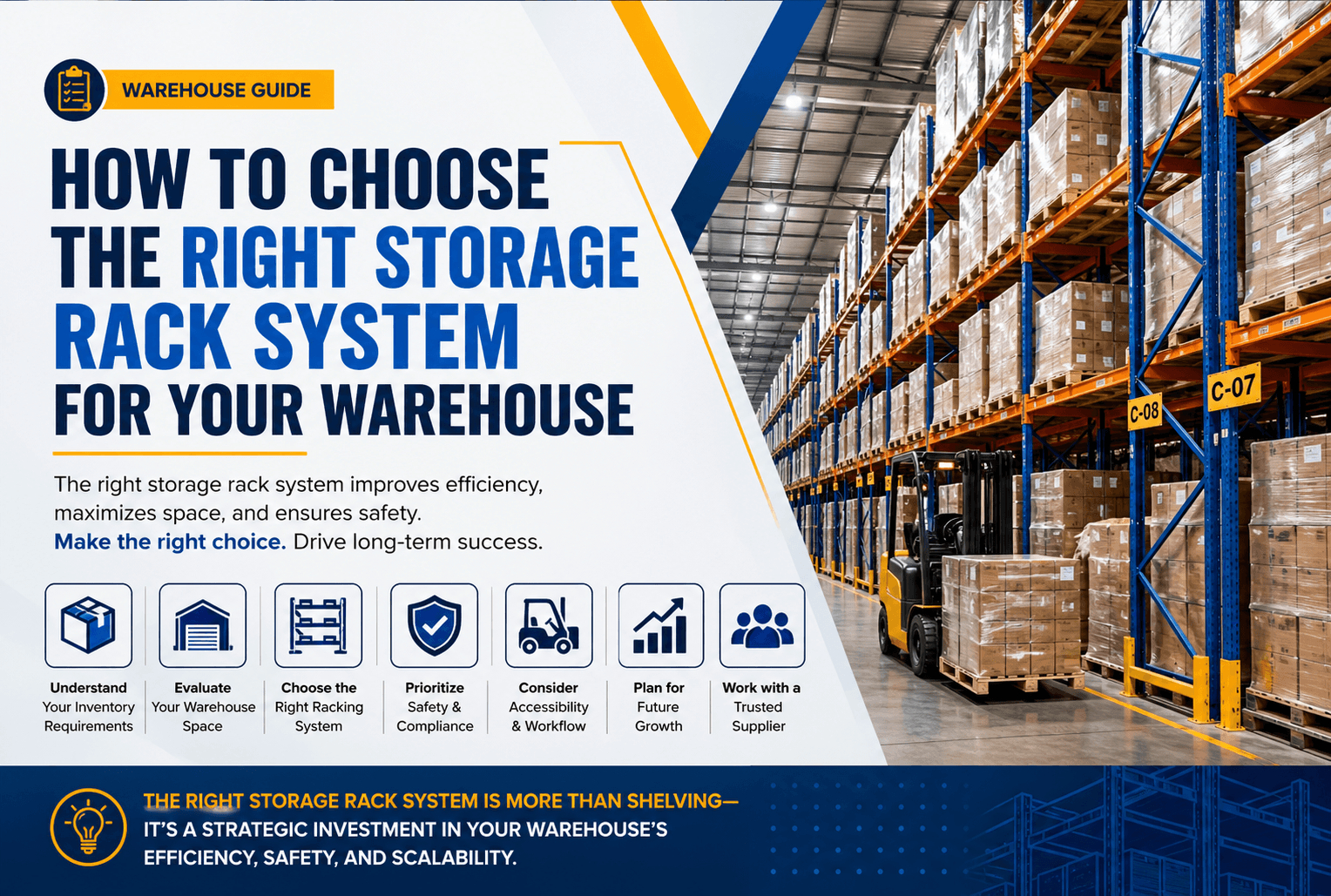
The wrong racking = wasted space and inefficiency. Here's how to choose right.
Key Factors
- Inventory: SKU count, turnover, dimensions
- Throughput: How fast do you move product?
- Space: Ceiling height, columns, floor capacity
- Budget: Initial cost vs. long-term ROI
- Growth: Where will you be in 5-10 years?
System Types
- Selective: High SKU access, lower density
- Drive-In: High density, LIFO, bulk storage
- Push-Back: 2-6 deep, LIFO, multiple SKUs
- Pallet Flow: FIFO, gravity-fed, date-sensitive
- 4D Shuttle: Max density + selectivity
- Cantilever: Long/irregular items
Bulldog Rack can analyze your needs and recommend the right solution.
Choosing the right storage rack system is one of the most consequential decisions you will make for your warehouse. The wrong choice does not just waste money—it creates operational inefficiencies that compound every day for the 15-20 year lifespan of the system. The right choice becomes a competitive advantage that improves throughput, reduces labor, and maximizes every cubic foot of your building.
This guide walks through the key decision factors and the major racking types so you can make an informed choice.
Step 1: Understand Your Inventory Profile
Before looking at racking types, you need a clear picture of what you are storing:
- SKU count—How many distinct products do you carry? A 50-SKU operation has fundamentally different racking needs than a 5,000-SKU operation.
- Pallet dimensions and weights—Standard 48x40 pallets at 2,000 lbs are the baseline. If you handle oversize, undersize, or mixed-weight loads, the racking must accommodate that.
- Turnover rate—Fast-movers need quick access. Slow-movers can go deeper. Understanding velocity by SKU is critical.
- Inventory rotation requirements—Do you need FIFO (first-in, first-out) for date-sensitive products? Or is LIFO (last-in, first-out) acceptable for non-perishable goods?
- Seasonal variation—If inventory volumes swing 30-50% seasonally, the racking system needs to handle peak volume without creating bottlenecks during normal periods.
Step 2: Assess Your Throughput Requirements
Throughput—how many pallets you put away and retrieve per hour—determines which racking configurations are viable:
- Low throughput (under 20 pallets/hour)—Most racking types work. Optimize for density.
- Medium throughput (20-60 pallets/hour)—Access speed and aisle configuration become important. Consider push-back, pallet flow, or shuttle systems.
- High throughput (60+ pallets/hour)—You need systems designed for speed: shuttle systems, pallet flow, or automated storage and retrieval. Aisle congestion becomes a limiting factor.
Tip: measure throughput at peak, not average. A system that handles your average day but collapses during peak season is a failed design.
Step 3: Evaluate Your Building
Your building is a fixed constraint. The racking must work within it:
- Clear height—The distance from the floor to the lowest hanging obstruction (sprinklers, lights, joists). Every foot of clear height is storage potential. A building with 32 feet of clear height can accommodate 5-6 beam levels; one with 40 feet can fit 7-8.
- Column spacing—Interior columns dictate where aisles and rack rows can go. Tight column grids (40x40 or less) limit layout options; wide spans (50x60 or more) provide flexibility.
- Floor slab capacity—High-density racking with deep lanes puts concentrated loads on the floor. The slab must support the point loads from fully loaded uprights. Older buildings may need floor reinforcement.
- Dock door locations—Product flow starts at the dock. Racking layouts should minimize the distance between receiving docks and storage, and between storage and shipping docks.
- Fire suppression—In-rack sprinkler requirements vary by racking type and storage height. ESFR (Early Suppression Fast Response) systems may be required above certain heights and affect beam-level placement.
Step 4: Compare Racking Systems
Here is an honest comparison of the major racking types. Every system has trade-offs—there is no universally “best” option.
Selective Racking
The most common system. Every pallet position is directly accessible from an aisle.
- Best for: High SKU count, frequent picking, mixed-product operations.
- Density: Low (35-45% space utilization). Wide aisles and single-deep lanes consume the most floor space.
- Access: 100% selectivity. Any pallet, any time.
- Cost: Lowest per position, but requires the most building space per pallet stored.
- Ideal when: You have 500+ SKUs, need immediate access to every pallet, and have sufficient building space.
Drive-In Racking
Pallets are stored multiple-deep in lanes that forklifts enter to place and retrieve loads.
- Best for: Bulk storage of few SKUs, LIFO operations, seasonal overflow.
- Density: High (60-75% space utilization). Eliminates intermediate aisles.
- Access: LIFO only. You can only access the front pallet. Inner pallets are blocked until front pallets are removed.
- Cost: Moderate. Higher per position than selective, but far fewer positions needed for the same capacity.
- Ideal when: You store large quantities of the same product and LIFO rotation is acceptable.
- Watch out for: Forklift damage (forklifts operating inside the rack structure cause the most damage), and limited selectivity makes it poor for high-SKU operations.
Push-Back Racking
Pallets are stored on nested carts that ride on inclined rails. Loading a new pallet pushes existing pallets back; removing the front pallet allows the next to roll forward.
- Best for: Medium-density storage with more SKU variety than drive-in. 2-6 pallets deep per lane.
- Density: Medium-High (50-65% space utilization).
- Access: LIFO. Front pallet only, but with more lanes than drive-in, you get better selectivity per SKU.
- Cost: Higher per position than drive-in due to cart and rail mechanisms.
- Ideal when: You have 20-200 SKUs with moderate depth per SKU, and need better selectivity than drive-in provides.
Pallet Flow Racking
Gravity-fed roller or wheel conveyors move pallets from the loading face to the picking face. Product is loaded at one end and retrieved at the other.
- Best for: FIFO operations, date-sensitive inventory, high-throughput picking.
- Density: Medium-High (50-65% space utilization).
- Access: FIFO guaranteed. First pallet loaded is first pallet picked. Essential for food, beverage, pharmaceutical, and any date-coded product.
- Cost: Highest per position of the static systems due to roller/wheel assemblies.
- Ideal when: Product rotation is critical and you cannot risk date-code violations or spoilage.
4D Shuttle Systems
Autonomous shuttles operate within the racking structure, handling put-away and retrieval without forklift entry into the lanes.
- Best for: Operations needing maximum density with maximum flexibility. Cold storage. High-throughput distribution.
- Density: Highest (70-85% space utilization). Deep lanes with no forklift aisles inside the rack.
- Access: Any pallet, any position. FIFO or LIFO. The shuttle retrieves whatever the WMS tells it to, regardless of lane position.
- Cost: Higher capital cost, but often the lowest total cost of ownership when labor savings and density gains are factored in.
- Ideal when: You need the density of drive-in with the selectivity of selective, want to reduce forklift labor, or operate in cold/freezer environments where minimizing human exposure is critical.
- Bulldog Rack offers: The 4D Lite (semi-autonomous, upgradeable) and the full 4D (fully autonomous, fleet-managed).
Cantilever Racking
Open-face racking with horizontal arms extending from vertical columns. No front uprights to obstruct loading.
- Best for: Long, bulky, or irregular items: lumber, pipe, steel, furniture, appliances.
- Density: Varies. Single-sided or double-sided configurations.
- Access: Full front access to every level. Easy to load and unload with forklifts or overhead cranes.
- Cost: Moderate. Bulldog Rack's Secure Pin Cantilever system offers tool-free arm adjustment and enhanced safety.
- Ideal when: Your products do not fit on standard pallets or your product mix requires frequent reconfiguration of arm heights.
Step 5: Think About the Future
The biggest mistake in racking selection is designing for today without considering where the business will be in 5-10 years:
- Will your SKU count grow? If yes, build in selectivity now even if you do not need it today.
- Will volume increase? Design for 120-130% of current volume to accommodate growth without a second racking project.
- Will you add automation? If shuttle systems are in your future, design racking that is shuttle-compatible from day one. Retrofitting later is possible but more expensive.
- Will your product mix change? Adjustable beam heights and modular racking configurations provide flexibility for evolving inventory profiles.
The Bottom Line
There is no one-size-fits-all answer to racking selection. The right system depends on your specific inventory, throughput, building, budget, and growth trajectory. What matters is making the decision with complete information—not defaulting to selective racking because it is familiar.
Bulldog Rack specializes in analyzing these factors and designing optimized storage solutions. We manufacture selective, drive-in, push-back, cantilever, and shuttle-compatible racking systems in the USA, and we will work with you to find the right combination for your operation.
Contact us for a free consultation and storage analysis.