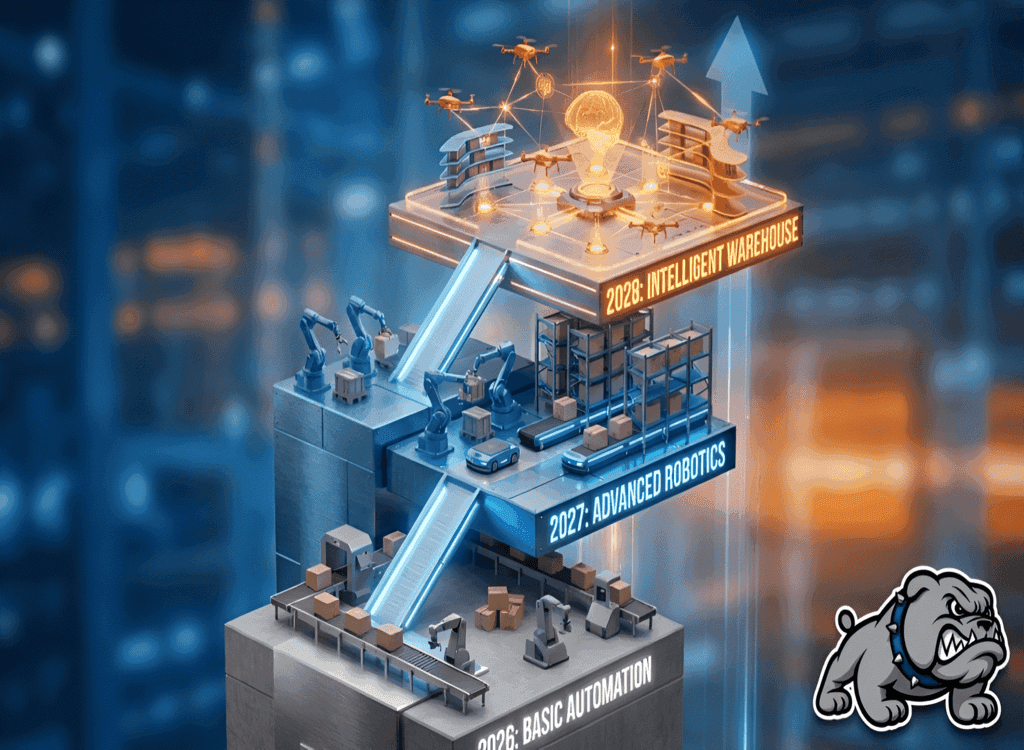
Pent-up capex demand is ready to surge across the warehouse industry.
What's Driving It
- Labor shortages and rising wages
- E-commerce demanding faster fulfillment
- Automation tech now accessible to mid-market
- Supply chain resilience mandates
- Interest rate stabilization
Where the Money Is Going
- Shuttle systems (2D and 4D)
- AS/RS for high-throughput facilities
- Goods-to-person picking
- WMS and controls upgrades
How to Position Now
- Audit your current storage utilization
- Model the ROI on automation
- Start with scalable systems like the 4D Lite
The wave is coming. Position now or get left behind.
The warehouse industry is on the brink of a seismic shift. After years of tight budgets, deferred maintenance, and cautious spending driven by economic uncertainty, pent-up capital expenditure demand is ready to surge. Companies that have been limping along with aging infrastructure and manual processes are running out of runway—and they know it.
The question is not whether the automation capex wave will hit. It is when—and whether your operation will be positioned to ride it or get caught underneath it.
What Is Driving the Wave?
Several forces are converging simultaneously to create the largest warehouse automation investment cycle in decades:
1. Labor Shortages Are Not Going Away
The warehouse labor crisis is structural, not cyclical. The U.S. faces a shortage of over 600,000 warehouse workers, and demographics are working against recovery. The workforce is aging, younger workers have more career options than ever, and the physical demands of traditional warehouse jobs make retention a constant battle. Automation is no longer a nice-to-have—it is the only viable path to maintaining throughput as the labor pool shrinks.
2. E-Commerce Growth Demands Speed
Consumer expectations for next-day and same-day delivery continue to intensify. Every major retailer is investing in fulfillment speed, and 3PLs are under pressure to match. Manual operations simply cannot keep pace with the throughput demands of modern e-commerce. The gap between what customers expect and what manual warehouses can deliver is widening every quarter.
3. Automation Technology Has Matured
Five years ago, warehouse automation was complex, expensive, and risky. Today, systems like the 4D Lite shuttle offer accessible entry points with proven reliability. WMS integration is standardized. Controls are intuitive. Implementation timelines have shortened. The technology is no longer bleeding-edge—it is production-ready and battle-tested.
4. Supply Chain Resilience Is Now a Board-Level Priority
The pandemic and subsequent supply chain disruptions taught every company the same lesson: fragile supply chains are existential risks. Buffer inventory, regional distribution, and flexible storage capacity are now strategic imperatives. Building that capacity with manual labor alone is not sustainable.
5. Interest Rates Are Stabilizing
As borrowing costs settle, the financial justification for capital investments improves dramatically. Projects that were shelved during rate hikes are being dusted off. CFOs who deferred automation spending are now seeing the ROI models work again—especially when factored against rising labor costs and the risk of lost competitiveness.
Where Is the Capex Going?
Not all automation investments are created equal. Here is where the smart money is flowing:
- Shuttle systems (2D, 4D Lite, and full 4D)—The fastest-growing segment. Shuttles offer the best balance of density, throughput, flexibility, and ROI. They work in existing buildings, scale incrementally, and do not require the massive civil works of AS/RS installations.
- High-density racking conversions—Companies are retrofitting selective racking to drive-in, push-back, or shuttle-compatible configurations to increase pallet positions without expanding their footprint.
- Cold storage automation—The economics of cold storage (high cost per square foot, harsh labor conditions, energy costs) make automation ROI compelling. Shuttle systems in freezer environments are seeing the fastest payback periods in the industry.
- WMS and controls upgrades—The software layer that ties automation together. Companies are investing in WMS platforms that can orchestrate shuttle fleets, optimize inventory placement, and provide real-time visibility.
- Goods-to-person picking—For high-SKU operations, bringing product to the picker instead of the picker to the product is delivering 3-5X throughput improvements.
The Danger of Waiting
Every capex cycle has the same pattern: early movers get the best lead times, the best pricing, and the most engineering attention. As the wave builds, lead times extend, costs rise, and project timelines stretch.
Companies that wait until the wave peaks will find:
- Equipment lead times stretched to 6-12+ months
- Engineering and installation capacity fully booked
- Steel and component costs inflated by demand
- Their competitors already operating with the throughput and cost advantages automation provides
The window to position ahead of the wave is now—not when every competitor is scrambling for the same resources.
How to Position Your Facility Today
You do not need to commit to a full automation overhaul tomorrow. But you should be taking concrete steps now:
- Audit your current storage utilization—Most facilities are using only 35-50% of their available cubic space. Understanding the gap is the first step to building a business case.
- Model the ROI—Work with a partner like Bulldog Rack to model the financial impact of automation. Factor in labor savings, throughput gains, damage reduction, and space optimization—not just equipment cost.
- Start with scalable systems—The 4D Lite is purpose-built for this moment. It delivers immediate automation benefits at a manageable investment, with a built-in upgrade path to full 4D when the business case supports it.
- Lock in engineering and manufacturing slots—Engaging early with manufacturers ensures your project gets the attention and timeline it needs before the rush.
- Think in phases—You can automate your highest-impact lanes first and expand over time. Phased deployment reduces risk and spreads capital expenditure across budget cycles.
The Bottom Line
The automation capex wave is not a prediction—it is already building. Labor shortages, e-commerce pressure, supply chain resilience mandates, and maturing technology are creating the perfect storm of pent-up demand. Companies that move now will ride the wave. Companies that wait will be catching up for years.
Bulldog Rack Company has the products, engineering expertise, and manufacturing capacity to help you get ahead of the curve. From conventional racking upgrades to 4D Lite shuttle deployments, we deliver turnkey solutions that position your operation for the decade ahead.
Contact us today to start the conversation.